
Every small business owner hits the same fork sooner or later. You’ve got a website, a tight budget, and plenty of people telling you to “get on Google.” So do you spend on SEO or put the money into ads? The SEO vs Google Ads question has no single right answer, but it does have a right answer for your business. This guide breaks the choice into five factors, so you can decide with real numbers in front of you instead of a gut feeling.
SEO vs Google Ads: what’s the actual difference?
SEO (search engine optimization) is the work you do to earn a spot in the organic results. You improve your pages, publish useful content, fix technical problems and build links until Google trusts your site enough to rank it. Nobody gets paid when a visitor clicks.
Google Ads is the paid side. You bid on keywords, write a short ad, and Google shows it above or below the organic results. You pay each time someone clicks, which is why it’s also called pay-per-click, or PPC. Stop paying and the ad disappears the same day.
Both put you in front of people who are already searching for what you sell. The difference is how you get there and what happens when you stop. That’s the core of SEO vs Google Ads.
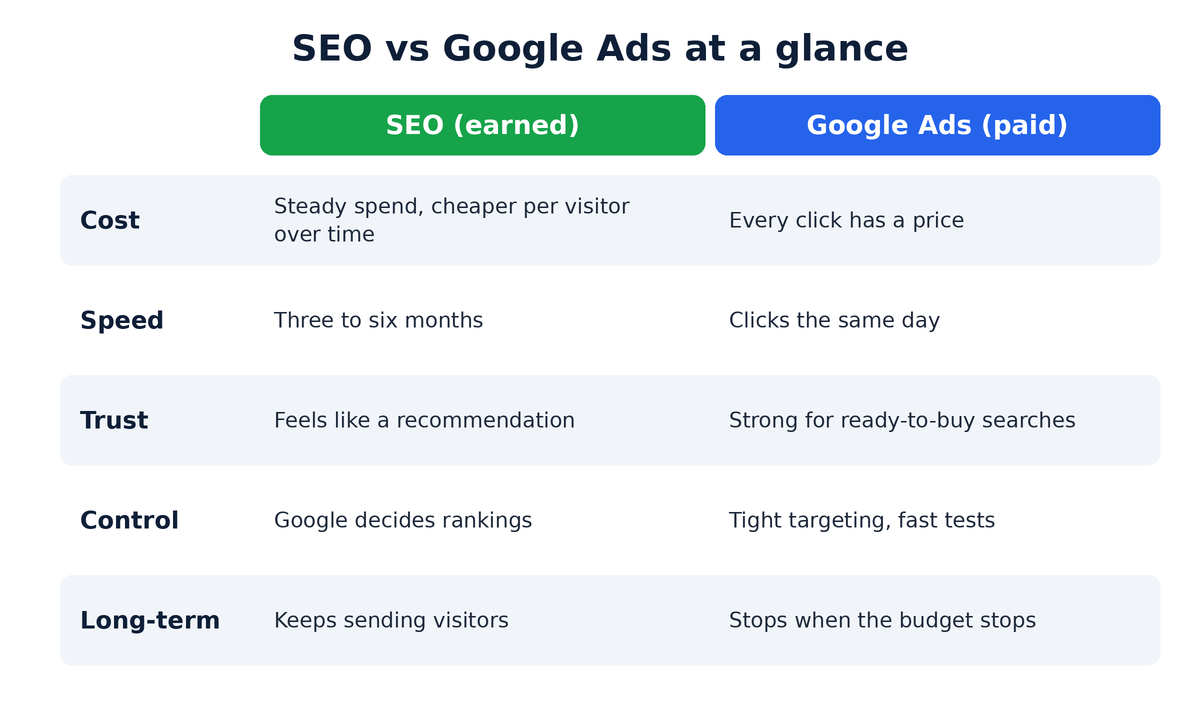
Factor 1: cost in SEO vs Google Ads
Google Ads costs money from the first click. The price depends on the keyword. A click for “plumber near me” costs far less than a click for “personal injury lawyer,” and competition in your city pushes prices around too. You set a daily budget, so you control the ceiling, but every visitor has a price tag.
SEO doesn’t charge per click, though it isn’t free. You pay in your own time or in fees to a freelancer or agency for content, technical fixes and link building. The spending is steadier, and once a page ranks, each extra visitor costs you nothing more.
Ads are cheaper to start and get more expensive the longer you run them. SEO is heavier upfront and gets cheaper per visitor as it builds. For a shop with a small monthly budget, that trade-off matters more than anything else in the SEO vs Google Ads debate.
Factor 2: speed of results
Ads win here. Launch a campaign in the morning and you can have clicks by the afternoon. That helps if you’re opening a new store, running a festival sale, or need leads this month.
SEO is slow. Waiting three to six months before you see real movement is common, and competitive keywords can take longer. Nobody can promise you a ranking date, so be wary of anyone who does.
If you need customers now, start with ads. If you can wait, SEO pays you back later.
Factor 3: trust and clicks in SEO vs Google Ads
Plenty of people scroll past ads. Some skip anything marked “Sponsored” and go straight to the Organic results, because a page that ranks on its own feels more like a recommendation than a pitch.
Ads still get clicks, especially from people who are ready to buy and see an ad that matches exactly what they typed. For searches with words like “buy,” “book” or “price,” a well-written ad can convert nicely. For research searches like “how to choose an accountant,” organic content usually does the work.
So the type of search matters as much as the channel. Buyers respond to ads. Learners respond to helpful pages.
Factor 4: control and targeting
Ads give you tight control. You pick the keywords, the city, the time of day, the device, even the exact wording. Change something and it goes live within minutes. You can test two headlines and know which one wins by the end of the week.
SEO gives you less control. You can shape your pages, but Google decides where they rank, and an algorithm update can move you overnight. The upside is that you’re not paying to run those tests.
Ads also give you cleaner data. You can see what each keyword cost and what it brought in. SEO tracking is fuzzier, since one blog post might bring readers who only become customers weeks later.
Factor 5: long-term value of SEO vs Google Ads
This is where SEO pulls ahead. A page that ranks keeps sending visitors for months or years without extra spending. Every blog post, service page and Google Business Profile update adds to something you own.
Ads are rented traffic. The day the budget hits zero, so does the traffic. Nothing carries over exceptthe data you learned.
Businesses that only run ads often feel stuck, because stopping means losing leads. Businesses that only do SEO can feel stuck too, waiting for growth to show up. Which brings us to the option most owners miss.
SEO vs Google Ads: why you may not need to pick one
Small businesses don’t have to treat this as a fight. A common approach is to run ads on the keywords that bring in buyers right now, while building SEO for the ones that will pay off next year. The ad data even tells you which keywords convert, so you can put your content effort where it counts.
Start small. A modest daily budget is enough to test what works, and a few solid service pages are enough to start ranking for local searches.
Say you run a tuition centre. Ads on “maths tuition near me” can fill your next batch, while blog posts and a Google Business Profile slowly build enquiries that don’t cost you per click. After six months you’ll know which channel brings in students at a lower cost. That result will settle your own SEO vs Google Ads split better than any general advice, including this article.
How to choose between SEO vs Google Ads
Ask yourself a few plain questions.
Do you need leads this month? Start with ads. Is your budget small but your timeline long? Start with SEO. Do you sell locally? Set up your Google Business Profile first. It’s free, and it helps with both local search and local ads.
Look at your margins too. If one customer is worth a lot, an expensive click can still pay off quickly. If you sell low-margin products, costly clicks are hard to justify. And if competitors are bidding hard on your main keywords, more specific searches like “kids school shoes near me” are usually easier to win with SEO.
Be honest about your capacity as well. Ads need someone checking the numbers every week. SEO needs someone publishing consistently. Either one fails when nobody owns it.
Mistakes to avoid with SEO vs Google Ads
Sending ad clicks to a slow or confusing website is the most common one. Every click costs money, and a bad landing page wastes it.
Expecting SEO results in a month, then quitting, is the second. Targeting broad keywords like “shoes” instead of specific ones is the third. And skipping tracking is the fourth: set up Google Analytics and conversion tracking before you spend a rupee.
Also, don’t copy a big brand’s plan. Their budget and goals aren’t yours. And don’t judge either channel too early: ads need a few weeks of data before they improve, and SEO needs months.
Not sure which one fits your business?
Every business has a different mix of budget, timeline and competition, and the SEO vs Google Ads choice looks different for each. If you’d like a second opinion, talk to our team. We’ll look at your website, your market and your numbers, then tell you where your first rupee should go.