
Most small businesses in India don’t fail because their product is bad. They fail because people can’t find them. Think about a tailor in Jaipur, a shop in Indore or a CA firm in Nagpur. Their potential customers are already searching on Google. They are scrolling through Instagram. They are looking for something to buy. Without a digital marketing strategy those customers go to the business that appears first. The one that shows up online.
This guide shares seven steps you can take this month. You can start with a small budget. You don’t need a marketing team. Just a plan.
Why Small Businesses in India Need a Digital Marketing Strategy
Hundreds of millions of people in India use the internet. Most of them use it on a phone. They check reviews before visiting a shop. They ask for prices on WhatsApp. They watch a video before they trust a brand. If your business is not part of these moments someone else takes the chance.
A digital marketing strategy is a plan. It decides where you show up. It decides what you say. It decides how you check if it worked. It replaces posting with steady effort. For a business with limited money that difference matters. You can’t afford to waste ₹10,000 on ads that go nowhere.
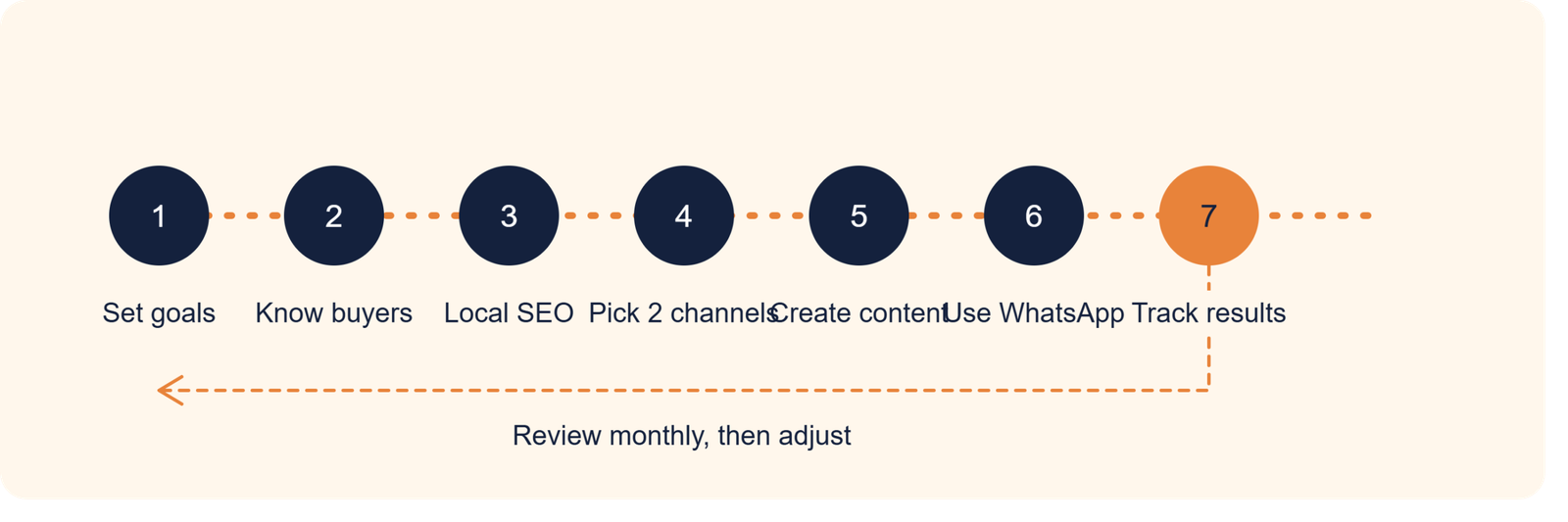
Step 1: Set Goals Before You Build a Digital Marketing Strategy
Start with one number. Maybe it is 30 enquiries a month. Maybe it is 50 store visits. Maybe it is ₹2 lakh in sales. A goal like “get followers” sounds good.. It doesn’t tell you anything. Followers don’t pay rent.
Write your goal in words. Add a deadline. Decide how you will measure it. Every choice after this—what platform you use, what content you make—should point toward that number. A digital marketing strategy without a goal is action. It is not progress.
Step 2: Know Who You Are Selling To
Be specific. “Everyone in Rajasthan” is not an audience. “Working women in their thirties who buy wear for family functions” is. Talk to your ten customers. Ask how they found you. Ask what almost stopped them from buying. Ask what made them say yes.
Those answers are more valuable than any report. They give you the words your customers actually use. You should use those words in your posts. Use them in your captions. Use them in your ads.
Step 3: Claim Your Google Business Profile and Local SEO
For local businesses this is the cheapest win. Set up your Google Business Profile. Add hours. Add a working phone number. Add photos. List your services. Then ask customers to leave a review. Reply to every review. Even the bad ones.
Add your city and area to your website pages. Add them to your service descriptions. Someone searching ” designer near me” or “CA in Jaipur” should find you. Local search brings people who’re ready to buy. That is why it belongs near the top of any marketing strategy for a small business.
Step 4: Choose Two Channels. Do Them Well
Trying to be on Instagram, YouTube, LinkedIn, Facebook and X all at once is how small teams burn out. Pick two.
Instagram and WhatsApp work well for retail, food, fashion and services sold to individuals. LinkedIn and Google search suit consultants, accountants and B2B sellers. Your customer research from Step 2 should answer the question. Go where your buyers already spend time. Ignore the rest until you have room to expand. A focused digital marketing strategy beats a scattered one every time.
Step 5: Create Content That Helps Before It Sells
People ignore ads they don’t care about. They pay attention to something. A clothing shop can show how to style one kurta three ways. A CA can explain a tax deadline in thirty seconds. A gym can share a home routine.
A good mix is 70 percent entertaining content. 20 Percent proof such as testimonials and results. 10 Percent direct offers. Use Hindi, English or a mix. That depends on how your customers talk. Short videos get the reach right now.. A clear photo post with a good caption still works. Consistency matters more than polish. Posting three times a week for six months beats posting daily for two weeks.
Content is the engine of your marketing strategy. Plan it a month ahead. Don’t decide each morning.
Step 6: Use WhatsApp to Turn Interest Into Sales
buyers like to talk before they pay. WhatsApp Business lets you set up a catalogue. It lets you set up replies. It lets you add a greeting message. All at no cost. Put a click-to-chat link in your Instagram bio. Put it on your website. Put it in your Google profile.
Reply fast. A lead that waits a day usually goes elsewhere. Keep a sheet of enquiries. Note who bought. Note who didn’t. Follow up once after a days. It feels small.. It’s often where sales close.
Step 7: Track Results and Improve Your Digital Marketing Strategy
You don’t need tools. Google Analytics, Instagram Insights and your own enquiry sheet are enough. Check them every month. Ask three questions. What brought the enquiries? What cost the most for the return? What should we do more of?
Drop what isn’t working. Even if you like it. Put effort and money behind what is. If you run paid ads start with ₹300 to ₹500 a day. Test two or three creatives. Let them run for a week before judging. Treat your marketing strategy as something you adjust every month. Not a document you write once.
Mistakes That Weaken a Digital Marketing Strategy
A errors happen again and again.
Buying followers or likes. They don’t buy anything. They drag down your engagement rate.
Boosting posts with no audience or goal. You pay for reach that goes nowhere.
Ignoring the website. If your site loads slowly on mobile or has no contact button you lose people you already paid to attract.
Copying a brand’s style. Their budget and audience are not yours.
Giving up after a month. Most channels need three to six months before results are clear.
Final Thoughts: Start Your Digital Marketing Strategy Today
You don’t need a budget to compete online. You need a goal. You need a defined customer. You need two channels. You need content. You need the habit of checking results. Start with Step 1 this week. Add one step every week after. Within two months you’ll have a working system. No more guesswork.
If you want to hand it over a good agency will start by asking about your goals and customers. Not, by pitching packages. That is usually the sign they know what they are doing.