
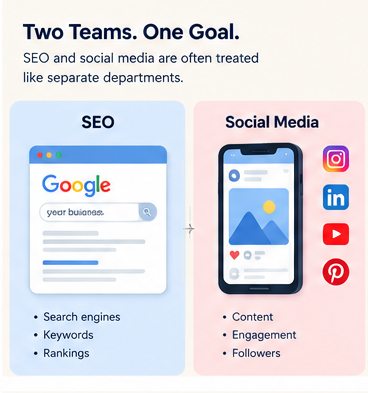
Most people talk about SEO and social media like they’re two different departments that occasionally send each other memos. SEO is “the Google thing.” Social media is “the content thing.” They live in separate tabs, separate strategies, separate people on the team.
That split doesn’t hold up anymore. And if you’ve ever wondered why a competitor’s Instagram post or LinkedIn article seems to show up everywhere — in Google results, in someone’s search when they type your niche plus “best,” in random blog roundups — you’re looking at SEO doing quiet work on a social post that never got a single paid boost.
Here’s the part that surprises people: Google doesn’t just index websites. It indexes a lot of your social presence too.
Your profiles are already competing in search
Search “your name + your city” or “your business + service” and see what comes up. There’s a decent chance a LinkedIn profile, a Pinterest board, a YouTube video, or even a public Facebook page shows up on page one — sometimes above the actual website. That’s not an accident. Google treats these as crawlable, indexable pages, same as any blog post.
Pinterest is the clearest example of a platform that’s basically a search engine wearing a social media costume. People go there to search for ideas, not to catch up with friends. If your pins aren’t titled and described with the actual terms people search for, you’re invisible on a platform built entirely around search intent.
YouTube works the same way. It’s the second-largest search engine on the planet, full stop. A video titled “How I Fixed X” with zero keyword thought behind it competes against a title like “How to Fix X in 2026 (Step-by-Step)” — and loses, every time, regardless of which video is actually better.
Captions and bios aren’t hashtags. They’re search fields.
There’s a habit of treating hashtags as the “SEO of Instagram.” They’re not, not really — hashtags are mostly a discovery mechanism within the platform’s own feed and explore tab. The actual SEO-adjacent move is different: writing your bio, your captions, and your video descriptions with the specific words a real person would type into a search bar.
If you run a bakery in Jaipur and your Instagram bio says “Sweet things for sweet people ,” Google has nothing to work with. If it says “Custom cakes and desserts in Jaipur,” you’ve just handed the algorithm something it can actually match to a search query. Same energy, more function.
This matters The traffic loop nobody talks about more now than it used to, because Google has been folding social results directly into search — video carousels, “people also discuss,” image packs pulled straight from Pinterest and Instagram. The line between “search result” and “social post” is blurrier every quarter.
The traffic loop nobody talks about
Here’s the mechanism that actually moves numbers, not vibes: social posts that rank in search bring in people who’ve never heard of your brand and weren’t following you. That’s cold traffic, arriving through intent rather than through an algorithm deciding to show you their feed. Some of that traffic clicks through to your website. Some of it just searches your brand name next, which is its own signal Google pays attention to — branded search volume is a trust signal, and social visibility is one of the easiest ways to generate it without spending on ads.
There’s also the boring but real backlink angle. A link in your Instagram or LinkedIn bio pointing to your website isn’t going to move mountains on its own — most of these are nofollow, so they don’t pass the traditional “SEO juice” people love talking about. But they generate actual click traffic, and traffic that converts or engages is still worth more than a theoretical ranking boost that never brings a single real visitor.
Where this gets oversold, and where it’s genuinely true
To be fair to the skeptics: social media “likes” and “shares” are not a direct Google ranking factor. Google has said this repeatedly, and testing backs it up. So if someone tells you “post more on Instagram to rank higher on Google,” that’s the oversimplified, LinkedIn-guru version of the truth.
What to actually do with this
• Treat your social bios and “about” sections as if they’re meta descriptions — because functionally, they behave like one.
• Write video titles and descriptions for search intent first, personality second.
• Stop assuming hashtags are doing SEO work. They’re doing discovery work. Different job.
• Track how much traffic actually arrives at your site from social search results, not just social feeds — Google Search Console will show you some of this if your content is indexed.
• Pick one platform where search behaviour is dominant (YouTube, Pinterest, sometimes LinkedIn for B2B) and optimise that one properly before spreading the effort thin across five.
SEO and social media were never really separate. They just got marketed that way by people selling separate services.