Blog

Blog

How to Read a Protein Powder Label: 7 Proven Steps to Stop Getting Fooled

Quick answer: To read a protein powder label, find the scoop weight in grams, work out protein per 100 g (protein per serving ÷ scoop weight × 100), check that the protein source is the first ingredient, scan for sweeteners and fillers, and look for an FSSAI licence number and a test report. It takes about two minutes. You’re holding a tub that says “25 g protein” in huge letters. The back is a wall of small print. Most people skip it and trust the front, which is marketing. Here’s how to read a protein powder label properly, step by step, so you can compare any two tubs. Why Learning How to Read a Protein Powder Label Saves Money Two tubs can both claim 24 g of protein and be very different products. The sticker price doesn’t tell you which is better value. Cost per gram of protein does. The formula: price ÷ (tub weight in grams × protein per 100 g ÷ 100). Tub A Tub B Price ₹3,000 ₹2,500 Tub weight 1 kg 1 kg Protein per 100 g 80 g 60 g Total protein in tub 800 g 600 g Cost per gram of protein ₹3.75 ₹4.17 The cheaper tub costs more per gram of protein. You only see that if you read the label. Step 1: Check the Serving Size First Everything on the panel is based on one serving, so start there. Look for the scoop weight in grams. “1 scoop” means nothing without a weight. Also check the number of servings. A 1 kg tub with a 40 g scoop gives you 25 servings, not 33. Step 2: Find Protein Per 100 g (the Fair Comparison) Labels usually show “per serving” and “per 100 g.” Use the per 100 g column to compare brands. If it’s missing, calculate it: protein per serving ÷ scoop weight × 100. A 30 g scoop with 24 g protein is 80 g per 100 g. A 40 g scoop with the same 24 g is 60 g per 100 g. Same headline, very different product. Why does a tub say 24 g protein when the scoop is 30 g? The scoop includes everything in the powder: flavour, sweetener, thickeners and a little moisture and fat. Only part of it is protein. As a rough benchmark, whey concentrate typically lands around 70 to 80 g per 100 g, and isolate reaches 90 g or more. Flavored products often sit lower. Step 3: How to Read a Protein Powder Label’s Ingredient List Ingredients are listed from largest amount to smallest. The protein source (whey concentrate, whey isolate or a plant protein) should come first. If sugar, maltodextrin or a “blend” appears before it, that tells you a lot. A short list is easier to judge. A long list isn’t automatically bad, but you should be able to explain why each item is there. Step 4: Spot Sweeteners, Fillers and Additives Sweeteners: sucralose, acesulfame potassium, aspartame, stevia, or sugar. Thickeners and gums: xanthan gum, guar gum, used for a creamier texture. Bulking carbs: maltodextrin and similar cheap fillers. Flavors and anti-caking agents: added for taste and texture. Most labels show total sugars and added sugars separately. Total sugars include lactose that naturally comes with milk protein. Added sugars are what the brand put in. That’s the line to watch. None of these additives is a problem at the levels used. The question is whether you want them. If you prefer a plain product, look for unflavoured or minimally sweetened options. Step 5: Know the Difference Between Concentrate and Isolate Whey concentrate usually has roughly 70 to 80% protein, with a bit more lactose and fat. Whey isolate is processed further and generally reaches 90% or more, with less lactose. Isolate costs more and isn’t better for everyone. If dairy sits fine with you, concentrate is good value. If lactose bothers you, isolate may suit you better. The label should state which one you’re getting, not just “whey protein.” Step 6: Watch for Proprietary Blends and Amino Spiking A “proprietary blend” lists a total weight but hides the amount of each ingredient. You can’t tell how much real protein you’re getting, so treat it as a yellow flag. Amino spiking is when cheap amino acids like glycine or taurine are added to push up the protein number, which is often estimated from nitrogen. A full amino acid profile helps you check. If you see leucine, BCAAs or EAAs on the panel, here’s what they mean: BCAAs are leucine, isoleucine and valine; EAAs are the nine essential amino acids your body can’t make. A real whey protein shows a full profile where leucine is a healthy share of the total, not a tiny number next to a large glycine figure. Step 7: Look for FSSAI Details, Batch Numbers and Test Reports In India, a label should carry the FSSAI logo and a 14-digit licence number, the veg or non-veg mark, manufacturing and expiry dates, and a batch number. Whey comes from milk, so it normally carries the green vegetarian dot. If any of these basics are missing, skip the product. You can check an FSSAI licence number on FSSAI’s official portal (FoSCoS). Better still, look for a third-party lab report, called a certificate of analysis (COA), that you can open. A claim on the tub is just a claim. A test report is evidence. Quick Checklist: How to Read a Protein Powder Label in Two Minutes Find the scoop weight in grams. Work out protein per 100 g. Check that the protein source is listed first. Separate added sugar from total sugar. Count the additives and decide if you’re fine with them. Confirm concentrate or isolate. Look for “proprietary blend” language. Check the FSSAI number and ask for a lab report. If a product passes all of these, you’re in good shape. If it fails two or three, keep looking. A Worked Example: Reading Our Own Label At Only What’s Needed, the […]
Blog

How to Grow Instagram Organically in 2026: Proven Tactics That Actually Work

Paying for followers is simple. Getting people who watch save and buy from you is difficult. If you want to grow Instagram without spending money in 2026 you need a plan, not one Reel. Organic growth means people find your account because your content is useful or entertaining with no money spent on ads. It takes longer than paying for reach. The people you grow stay interested. This guide covers what we tell our clients step by step. Why most accounts struggle to grow Instagram without spending money Most accounts post whatever comes to mind and hope the algorithm notices. That rarely works. Instagram shows a post to a group of people first and watches how they react. If people skip or leave quickly the post doesn’t go far. So the real job is simple to say and hard to do: make content that a stranger finishes, saves or sends to a friend. Everything below serves that goal. Fix your profile before you try to grow Instagram without spending money Someone lands on your profile after seeing one Reel. You have very little time to convince them to follow. Check these four things. Your name field should include the phrase people would search for such as “Digital Marketer | Jaipur”. Your bio should say who you help and what they get. Your profile photo should be clear at a small size.. Your link should go somewhere useful not a dead page. Pin three posts that show your work or explain what you do. A new visitor should understand your account in one scroll. Pick one audience. Talk to them Accounts that try to speak to everyone end up speaking to no one. Decide who you’re making content for: first-time founders, local shop owners, college students. Then write down five problems that person has this month. Those five problems become your content pillars. A bakery might use recipes behind the scenes customer stories, cake care tips and offers. Each post fits one pillar so followers know what to expect and have a reason to stay. A narrow focus is the way to grow Instagram without spending money because the algorithm can tell who your content is for. Make Reels the core of how you grow Instagram without spending money Reels still reach non-followers more than any format so they’re your main discovery tool. A few things matter more than editing skills. The first line decides everything. Say the point. Show the result in the opening seconds then explain. “Three Instagram mistakes that cost you reach” works better than an intro with your logo. Keep it tight. Cut pauses, remove filler words. End the moment you’ve made your point. A 20-second Reel that people watch twice beats a 60-second one they abandon. Use on-screen text since many people watch with the sound off.. End with one clear next step like “save this for later” or “send this to someone who needs it.” Use carousels to grow Instagram without spending money through saves and shares Carousels do a job from Reels. They keep people on your post longer. Make saving easy. That makes them good for checklists, comparisons, step-by-step guides and myth-busting. Make the first slide a clear promise, put one idea on each slide and keep the text large to read on a phone. The last slide should ask for a save or a share not just say thanks. If a carousel does well turn it into a Reel. If a Reel does well expand it into a carousel. You’re reusing ideas that already work. Write captions that Instagram search can find Instagram works like a search engine now. People look up topics like “GST filing tips” or “meal prep for beginners”. The platform reads your caption, on-screen text and alt text to decide what your post is about. Use the phrases your audience types in the first sentence of your caption. Write in language. Add a few hashtags but don’t stuff them in. Five focused tags do than thirty random ones and the caption matters more than the tags. Post consistently without burning out Consistency beats intensity. Posting every day for two weeks and then vanishing for a month teaches the algorithm and your followers nothing. Pick a schedule you can keep for example three Reels and two carousels a week. Batch your work. Spend one afternoon planning topics. Writing hooks. Spend another filming. Schedule everything then leave time to reply to comments. Batching cuts the stress that makes most people quit. It’s also what lets you grow Instagram without spending money over months of weeks. Engage like a person, not a scheduler Posting is half the job. Reply to every comment in the hour if you can because early activity tells Instagram people care about the post. Ask questions in your captions so theres something to answer. Spend ten minutes a day on accounts in your niche. Leave comments that add something, not “nice post”. Answer your DMs. Those small conversations turn followers into customers. You grow Instagram without spending money faster when people actually know who you are. Collaborate to grow Instagram without spending money faster Collab posts show up on both accounts and reach each audience. Look for creators or businesses that serve the people you do but don’t compete with you: a CA and a financial planner a gym and a nutritionist a photographer and a wedding planner. Propose something like a joint Reel or a shared carousel and say what each side gets. Vague “lets collaborate” messages get ignored. Also share user-generated content when customers tag you. It’s proof that real people like what you do. Track what works and drop what doesn’t Open Insights every week and look at a numbers: reach from non-followers, saves, shares, watch time and profile visits. Likes are the signal. Saves and shares tell you the content was useful. Find your three posts of the month and ask what they have in common. Maybe it’s a topic, a hook […]

Blog

Digital Marketing Strategy for Small Businesses in India: 7 Proven Steps to Win More Customers

Most small businesses in India don’t fail because their product is bad. They fail because people can’t find them. Think about a tailor in Jaipur, a shop in Indore or a CA firm in Nagpur. Their potential customers are already searching on Google. They are scrolling through Instagram. They are looking for something to buy. Without a digital marketing strategy those customers go to the business that appears first. The one that shows up online. This guide shares seven steps you can take this month. You can start with a small budget. You don’t need a marketing team. Just a plan. Why Small Businesses in India Need a Digital Marketing Strategy Hundreds of millions of people in India use the internet. Most of them use it on a phone. They check reviews before visiting a shop. They ask for prices on WhatsApp. They watch a video before they trust a brand. If your business is not part of these moments someone else takes the chance. A digital marketing strategy is a plan. It decides where you show up. It decides what you say. It decides how you check if it worked. It replaces posting with steady effort. For a business with limited money that difference matters. You can’t afford to waste ₹10,000 on ads that go nowhere. Step 1: Set Goals Before You Build a Digital Marketing Strategy Start with one number. Maybe it is 30 enquiries a month. Maybe it is 50 store visits. Maybe it is ₹2 lakh in sales. A goal like “get followers” sounds good.. It doesn’t tell you anything. Followers don’t pay rent. Write your goal in words. Add a deadline. Decide how you will measure it. Every choice after this—what platform you use, what content you make—should point toward that number. A digital marketing strategy without a goal is action. It is not progress. Step 2: Know Who You Are Selling To Be specific. “Everyone in Rajasthan” is not an audience. “Working women in their thirties who buy wear for family functions” is. Talk to your ten customers. Ask how they found you. Ask what almost stopped them from buying. Ask what made them say yes. Those answers are more valuable than any report. They give you the words your customers actually use. You should use those words in your posts. Use them in your captions. Use them in your ads. Step 3: Claim Your Google Business Profile and Local SEO For local businesses this is the cheapest win. Set up your Google Business Profile. Add hours. Add a working phone number. Add photos. List your services. Then ask customers to leave a review. Reply to every review. Even the bad ones. Add your city and area to your website pages. Add them to your service descriptions. Someone searching ” designer near me” or “CA in Jaipur” should find you. Local search brings people who’re ready to buy. That is why it belongs near the top of any marketing strategy for a small business. Step 4: Choose Two Channels. Do Them Well Trying to be on Instagram, YouTube, LinkedIn, Facebook and X all at once is how small teams burn out. Pick two. Instagram and WhatsApp work well for retail, food, fashion and services sold to individuals. LinkedIn and Google search suit consultants, accountants and B2B sellers. Your customer research from Step 2 should answer the question. Go where your buyers already spend time. Ignore the rest until you have room to expand. A focused digital marketing strategy beats a scattered one every time. Step 5: Create Content That Helps Before It Sells People ignore ads they don’t care about. They pay attention to something. A clothing shop can show how to style one kurta three ways. A CA can explain a tax deadline in thirty seconds. A gym can share a home routine. A good mix is 70 percent entertaining content. 20 Percent proof such as testimonials and results. 10 Percent direct offers. Use Hindi, English or a mix. That depends on how your customers talk. Short videos get the reach right now.. A clear photo post with a good caption still works. Consistency matters more than polish. Posting three times a week for six months beats posting daily for two weeks. Content is the engine of your marketing strategy. Plan it a month ahead. Don’t decide each morning. Step 6: Use WhatsApp to Turn Interest Into Sales buyers like to talk before they pay. WhatsApp Business lets you set up a catalogue. It lets you set up replies. It lets you add a greeting message. All at no cost. Put a click-to-chat link in your Instagram bio. Put it on your website. Put it in your Google profile. Reply fast. A lead that waits a day usually goes elsewhere. Keep a sheet of enquiries. Note who bought. Note who didn’t. Follow up once after a days. It feels small.. It’s often where sales close. Step 7: Track Results and Improve Your Digital Marketing Strategy You don’t need tools. Google Analytics, Instagram Insights and your own enquiry sheet are enough. Check them every month. Ask three questions. What brought the enquiries? What cost the most for the return? What should we do more of? Drop what isn’t working. Even if you like it. Put effort and money behind what is. If you run paid ads start with ₹300 to ₹500 a day. Test two or three creatives. Let them run for a week before judging. Treat your marketing strategy as something you adjust every month. Not a document you write once. Mistakes That Weaken a Digital Marketing Strategy A errors happen again and again. Buying followers or likes. They don’t buy anything. They drag down your engagement rate. Boosting posts with no audience or goal. You pay for reach that goes nowhere. Ignoring the website. If your site loads slowly on mobile or has no contact button you lose people you already paid to attract. Copying a brand’s style. Their budget and […]

Phone full of likes and followers next to a cash register showing zero rupees
Blog

Is Digital Marketing Worth It for Small Businesses? The Honest Truth

Most small business owners get to the place at some point. You’re spending money on ads. You’re posting on Instagram every days.. You still can’t tell if any of it is bringing in real customers. Meanwhile the shop down the road paid for one hoarding years ago and still seems to be doing So is digital marketing worth it when your budget is tight and your team is just you and one assistant? In cases yes.. It depends on how you do it. Many businesses try it and fail and that’s why digital marketing has a bad reputation. Here’s the full story. Including the parts that don’t work well. Why digital marketing for businesses has a bad reputation Ask ten business owners and a few will have a horror story. A freelancer who promised 10,000 followers and delivered ones. An agency that sent a report full of impressions and zero sales. A boosted post that cost ₹5,000 and got two likes. From relatives. These stories are real.. They explain the doubt. But look closer. The problem is almost never the channel. It’s the lack of a goal. When no one decides what a campaign is supposed to produce. Calls, store visits form fills. No one can tell if it worked. Spending without a target is an idea in any medium whether it’s print or online. What digital marketing costs compared to traditional advertising Advertising asks for a big payment up front. A newspaper ad, a hoarding or a radio spot is paid for before you know anything about the result. You can’t see who actually responded. Digital marketing works differently. You can start with an amount see the numbers within days and change course quickly. If an ad isn’t getting clicks you pause it. If a post gets saved and shared you make more like it. That control matters most to businesses. Because one wasted month hurts more when you don’t have cash to begin with. It also lets you reach an audience. A tuition centre in a -sized city doesn’t need every person in India to see its ad. It needs parents of Class 11 students within a kilometre. Targeting by location, age and interest makes that possible. Where digital marketing pays off for small businesses search comes first. When someone types “dentist near me” or “bakery open now” they’re ready to buy. A complete Google Business Profile with hours photos and reviews costs nothing and can bring in more customers than a paid campaign. Social media is next. Instagram and Facebook work well for businesses that sell something people can see. Clothing, food, jewellery, home décor. They also work for service providers who build trust by explaining things. Accountants, lawyers, fitness trainers. Regular posting makes people familiar with you before they need you. WhatsApp and email get ignored because they’re not exciting. They reach people who already know you. A short message about an arrival or a seasonal offer to existing customers costs almost nothing and tends to bring repeat sales. Then there’s content and SEO. Blogs and videos that answer customer questions keep bringing visitors for months after you publish them. It’s slow. It’s the one channel where the effort compounds instead of disappearing when you stop paying. Paid ads are the option and also the easiest place to waste money. They work best when someone is already searching for what you sell. Like a Google search ad for “wedding photographer”. They work well when you’re trying to convince strangers on social media who weren’t thinking about you. Start with a daily budget run one clear offer and check the enquiries before you spend more. When digital marketing is not worth it Some businesses should. It’s better to say so plainly. Even businesses that are ready tend to make the few mistakes. They try to be on every platform at and end up doing everything half-heartedly. They change strategy every two weeks. They send people to a homepage with no next step so interested visitors leave without calling. Picking two channels and doing them consistently beats being If your product or service isn’t good yet marketing will only send people to a disappointing experience. If you have no way to handle enquiries. Say nobody answers the phone or replies to DMs. You’ll pay to generate leads. Then lose them.. If you need results next week from a ₹2,000 budget you’ll be disappointed with any channel. Digital marketing also takes time. Paid ads can bring enquiries within days. Trust, search rankings and a loyal audience take months. Owners who quit after four weeks usually quit right before things would have started working. How to measure marketing results without a data team You don’t need complicated dashboards. Pick one number per channel that connects to money. For your Google Business Profile that’s calls and direction requests. For Instagram it’s DMs, enquiries and link clicks. For ads it’s cost per enquiry. For email and WhatsApp it’s replies and repeat orders. Likes and followers feel good. Pay no bills. Track them if you like. Don’t let them decide your budget. Ask every customer how they found you. A simple question at billing or on the call gives you better data than most reports. A realistic digital marketing budget for businesses There’s no universal figure and anyone quoting one without knowing your margins is guessing. A useful approach is to start from what an average customer is worth to you. If a new customer brings you ₹3,000 in profit over time spending ₹500 to get one is a deal. Spending ₹3,500 isn’t. Start small. Put most of the effort into cheap digital marketing channels first: your Google profile, regular posting and messaging past customers. Add an ad budget once you know what a customer enquiry looks like and what you can afford to pay for one. Increase spending on what’s visibly working. Review the numbers once a month not every day because daily swings in ad results are mostly noise. Should […]

Blog

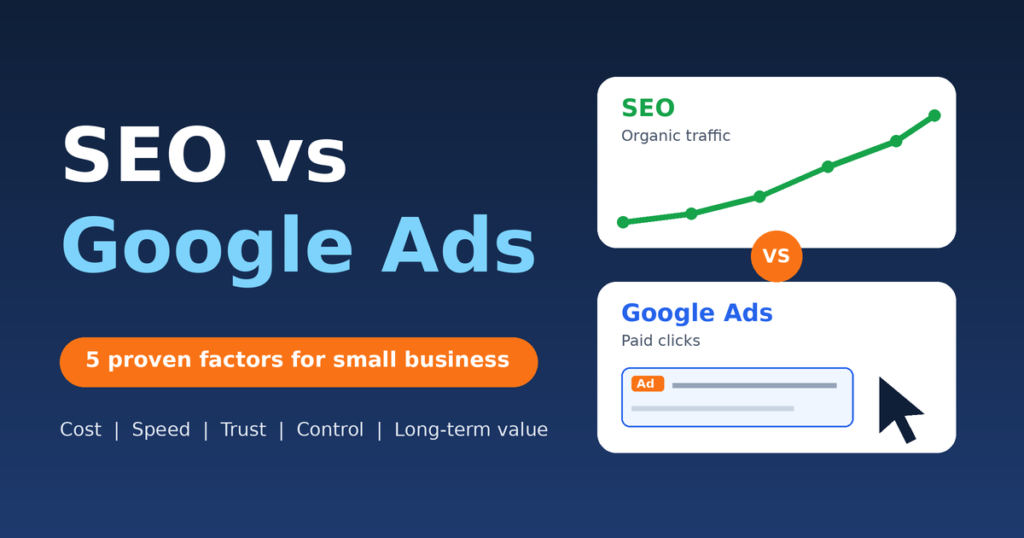
SEO vs Google Ads: 5 Proven Factors for Small Business

Every small business owner hits the same fork sooner or later. You’ve got a website, a tight budget, and plenty of people telling you to “get on Google.” So do you spend on SEO or put the money into ads? The SEO vs Google Ads question has no single right answer, but it does have a right answer for your business. This guide breaks the choice into five factors, so you can decide with real numbers in front of you instead of a gut feeling. SEO vs Google Ads: what’s the actual difference? SEO (search engine optimization) is the work you do to earn a spot in the organic results. You improve your pages, publish useful content, fix technical problems and build links until Google trusts your site enough to rank it. Nobody gets paid when a visitor clicks. Google Ads is the paid side. You bid on keywords, write a short ad, and Google shows it above or below the organic results. You pay each time someone clicks, which is why it’s also called pay-per-click, or PPC. Stop paying and the ad disappears the same day. Both put you in front of people who are already searching for what you sell. The difference is how you get there and what happens when you stop. That’s the core of SEO vs Google Ads. Factor 1: cost in SEO vs Google Ads Google Ads costs money from the first click. The price depends on the keyword. A click for “plumber near me” costs far less than a click for “personal injury lawyer,” and competition in your city pushes prices around too. You set a daily budget, so you control the ceiling, but every visitor has a price tag. SEO doesn’t charge per click, though it isn’t free. You pay in your own time or in fees to a freelancer or agency for content, technical fixes and link building. The spending is steadier, and once a page ranks, each extra visitor costs you nothing more. Ads are cheaper to start and get more expensive the longer you run them. SEO is heavier upfront and gets cheaper per visitor as it builds. For a shop with a small monthly budget, that trade-off matters more than anything else in the SEO vs Google Ads debate. Factor 2: speed of results Ads win here. Launch a campaign in the morning and you can have clicks by the afternoon. That helps if you’re opening a new store, running a festival sale, or need leads this month. SEO is slow. Waiting three to six months before you see real movement is common, and competitive keywords can take longer. Nobody can promise you a ranking date, so be wary of anyone who does. If you need customers now, start with ads. If you can wait, SEO pays you back later. Factor 3: trust and clicks in SEO vs Google Ads Plenty of people scroll past ads. Some skip anything marked “Sponsored” and go straight to the Organic results, because a page that ranks on its own feels more like a recommendation than a pitch. Ads still get clicks, especially from people who are ready to buy and see an ad that matches exactly what they typed. For searches with words like “buy,” “book” or “price,” a well-written ad can convert nicely. For research searches like “how to choose an accountant,” organic content usually does the work. So the type of search matters as much as the channel. Buyers respond to ads. Learners respond to helpful pages. Factor 4: control and targeting Ads give you tight control. You pick the keywords, the city, the time of day, the device, even the exact wording. Change something and it goes live within minutes. You can test two headlines and know which one wins by the end of the week. SEO gives you less control. You can shape your pages, but Google decides where they rank, and an algorithm update can move you overnight. The upside is that you’re not paying to run those tests. Ads also give you cleaner data. You can see what each keyword cost and what it brought in. SEO tracking is fuzzier, since one blog post might bring readers who only become customers weeks later. Factor 5: long-term value of SEO vs Google Ads This is where SEO pulls ahead. A page that ranks keeps sending visitors for months or years without extra spending. Every blog post, service page and Google Business Profile update adds to something you own. Ads are rented traffic. The day the budget hits zero, so does the traffic. Nothing carries over exceptthe data you learned. Businesses that only run ads often feel stuck, because stopping means losing leads. Businesses that only do SEO can feel stuck too, waiting for growth to show up. Which brings us to the option most owners miss. SEO vs Google Ads: why you may not need to pick one Small businesses don’t have to treat this as a fight. A common approach is to run ads on the keywords that bring in buyers right now, while building SEO for the ones that will pay off next year. The ad data even tells you which keywords convert, so you can put your content effort where it counts. Start small. A modest daily budget is enough to test what works, and a few solid service pages are enough to start ranking for local searches. Say you run a tuition centre. Ads on “maths tuition near me” can fill your next batch, while blog posts and a Google Business Profile slowly build enquiries that don’t cost you per click. After six months you’ll know which channel brings in students at a lower cost. That result will settle your own SEO vs Google Ads split better than any general advice, including this article. How to choose between SEO vs Google Ads Ask yourself a few plain questions. Do you need leads this month? Start with ads. Is your budget small […]

Blog

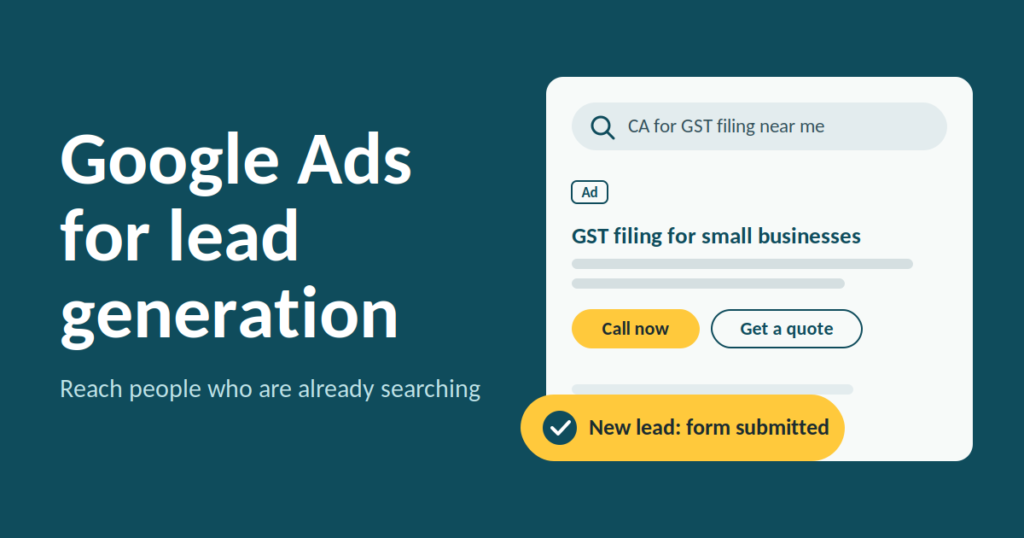
6 Powerful Google Ads Lead Generation Tips: Stop Losing Leads

Most businesses don’t have a traffic problem. They have a lead problem. People land on the website, scroll for ten seconds and leave without calling, filling a form or sending a WhatsApp message. Google Ads can fix a big part of that, because it puts your offer in front of people who are already searching for what you sell. This post explains how Google Ads help in lead generation, where campaigns usually go wrong, and what to fix first. Why Google Ads work: people are already searching Social media ads interrupt people. Someone is watching reels, and your ad shows up between two videos. Search ads work the other way round. A person types “GST registration consultant” or  “dentist for root canal” because they need it now, and your ad appears on that page. That difference in intent is the main reason lead generation through search works so well. You aren’t trying to create interest from nothing. You’re showing up at the moment someone has already decided they need help, and all you have to do is look like the right choice. You also pay only when someone clicks. Impressions are free, so a weak headline costs you very little until people start clicking on it. That’s a good reason to test copy early and often. Google Ads lead generation starts with the right keywords Keywords decide who sees your ad, so most of the result is settled here. Not every keyword is worth buying, though. Compare two searches: “what is income tax audit” and “CA for income tax audit near me”. The first person is probably a student or someone curious. The second person is ready to hire. If your goal is leads, the second kind of search should get most of your budget. Match types matter too. Broad match casts a wide net and can send your ad to searches that have nothing to do with your service. Phrase and exact match keep things tighter. Then there are negative keywords, which are searches you tell Google to ignore. Words like “free”, “jobs”, “course” or “salary” usually bring clicks that never turn into enquiries. Check the search terms report every week and add new negatives as you find them. It’s boring work, and it saves a surprising amount of money. Targeting in Google Ads: reach the right people, not everyone A good keyword list can still waste money if the wrong people see the ad. The platform gives you a few controls that fix this. Location is the first one. A local clinic doesn’t need clicks from another state, so you can limit ads to a city or a radius around your office. Ad scheduling is the second. If nobody picks up the phone after 8 1pm, there’s little point paying for calls at 10 pm. Device settings help too, especially if your landing page works better on mobile than on desktop, or the other way round. Then there’s remarketing, which the platform now labels “your data” segments. Most visitors don’t enquire the first time. Remarketing shows your ad again to people who already visited your site, which keeps you in front of someone who was interested but got distracted. For services with a longer decision cycle, like financial planning or B2B software, this often brings back leads you’d otherwise lose. Ad copy and assets that help Google Ads convert Your ad has a few lines to work with, so each one has to earn its space. Put the keyword in the headline, say what makes you different, and tell people what to do next. “Free 15-minute consultation” is stronger than “Contact us today” because it’s specific and it lowers the risk of taking the first step. Assets add more to the ad without extra cost per line. Call assets put a phone number in the ad so mobile users can ring you with one tap. Sitelinks send people to specific pages such as pricing or a particular service. Lead form assets let people submit their details inside Google without visiting your site at all, which works well when your landing page is slow or weak. Expect lower quality leads from forms, though, since filling one takes almost no effort. Call them quickly and you’ll find out which ones are real. Landing pages decide whether Google Ads leads become enquiries You can pay for the perfect click and still lose it on the landing page. This is where a lot of campaigns fall apart, and it’s rarely the ad’s fault. A good landing page does one thing. If the ad promised a GST filing service, the page should be about GST filing, with a clear headline, a short explanation, proof that you’re credible, and one form or button. Sending traffic to your homepage is the classic mistake. The visitor has to hunt for what they came for, and most won’t bother. Speed matters as well. If the page takes more than a few seconds to load on a mobile connection, people leave before they see anything. Keep the form short. Name, phone number and one question is often enough. Every extra field costs you a few leads. Tracking Google Ads results so you can cut what isn’t working Without conversion tracking, you’re guessing. Set up tracking for form submissions, phone calls and WhatsApp clicks before you spend anything serious. Then you can see which keywords, ads and locations produce enquiries and which just produce clicks. The number to watch is cost per lead, not cost per click. A keyword with an expensive click can still be your cheapest source of leads if it converts well, and a cheap click that never converts is expensive whatever the price says. Look at Quality Score too. It’s Google’s rating of how relevant 2your ad, keyword and landing page are to each other. Google treats it as a diagnostic rather than a ranking input, so use it to spot weak ads or landing pages instead of chasing the number. Give campaigns time […]

Blog

Why Digital Marketing Is the Ultimate Survival Tool in 2026

Ten years ago, a business could survive on word-of-mouth, a signboard, and maybe a newspaper ad. That world is gone. Today, if you don’t show up online, you effectively don’t exist for a huge share of your potential customers. This is exactly why digital marketing has become the single most powerful growth lever for businesses of every size. What Digital Marketing Actually Means Today It isn’t just running a few Instagram ads or posting once a week. It’s the entire ecosystem of how a brand gets discovered, evaluated, and chosen online — search engines, social media, email, content, paid ads, and analytics working together as one relentless system. Businesses that treat this as a side activity almost always underinvest, then wonder why compe titors are pulling ahead effortlessly. A proper strategy touches every stage of the customer journey: someone searches for a solution, finds your content or ad, checks your social proof, and eventually converts. Miss any one of those touchpoints and you hand a guaranteed customer to someone who didn’t. c Why Digital Marketing Levels the Playing Field for Small Businesses Traditional advertising favoured whoever had the biggest budget. TV ads, print spreads, and billboards were pay-to-play games small businesses couldn’t win. This shift broke that model completely. A small business with a sharp strategy, precise targeting, and consistent output can now outperform a much bigger competitor with a lazier approach. This is one of the most underrated reasons it matters right now: it rewards relevance and consistency over raw spending power. A local bakery with a well-run Instagram page and Google Business profile can beat a national chain in local search — something structurally impossible before. Why Digital Marketing Is Where Your Customers Already Are There’s a simple, uncomfortable truth here: your customers are online whether you are or not. They’re researching products on Google, comparing options on Instagram and YouTube, and reading reviews before they trust a brand. If your presence is weak or absent, you’re not neutral in their eyes — you look outdated, unreliable, or worse, invisible. This is why even businesses that rely heavily on offline sales, like local retail or services, can’t afford to skip it. A weak online footprint actively damages the offline funnel too, because most buying decisions today start with a search, not a walk-in. Why Digital Marketing Delivers Explosive, Measurable Results One of the strongest arguments here is something traditional advertising could never offer: airtight measurability. Every click, impression, conversion, and drop-off point is trackable. You know exactly what’s working and what’s burning money, and you can fix underperforming campaigns within days, not months. This changes the entire risk profile of marketing spend. With this system, a bad campaign is a quick lesson you course-correct fast. A badly designed billboard, by contrast, is a sunk cost for the full contract period — with zero real way to prove it did anything. Why Digital Marketing Builds Unshakeable Trust Faster Than Any Other Channel Trust used to take years to build. Now, a business can build credibility in months through consistent, high-value content, honest engagement, and visible social proof like reviews and testimonials. Customers research a brand extensively before buying, and what they find during that research decides the sale far more than any single ad does. This is precisely why a channel focused only on selling, without delivering real value, tends to flop. Audiences can tell the difference between a brand trying to help them and one trying to extract money from them, and they punish the latter without mercy. Why Ignoring Digital Marketing Is a Costly, Avoidable Risk Here’s the part most businesses underestimate: not doing this isn’t a neutral choice — it’s an active, compounding disadvantage. While you’re deciding whether it’s “worth the investment,” your competitors are already capturing the search traffic, the social attention, and the customer trust that should have been yours. Budgets that seem small compared to traditional ad spends routinely outperform them by a wide margin, simply because they’re targeted, trackable, and constantly optimized. Businesses that delay adoption don’t stay neutral — they slowly lose relevance while sharper competitors pull further ahead. Getting Digital Marketing Right Is Non-Negotiable The case here isn’t theoretical anymore — it’s the difference between businesses that grow predictably and those that stagnate while wondering where their customers went. Search visibility, social presence, content, and paid strategy aren’t separate checkboxes; they’re one connected, unstoppable system that determines whether a business is found, trusted, and chosen. If there’s one lesson worth taking from this, it’s that consistency wins and hesitation costs. The businesses winning today aren’t necessarily the ones with the biggest budgets — they’re the ones who understood early that this isn’t a marketing department’s side project. It’s the front door to the business itself.

Blog

7 Proven SEO Ranking Secrets to Skyrocket Your Website in 2026

Most website owners treat SEO like a black box — throw in some keywords, wait, hope for the best. That’s why they stay stuck on page 4 while competitors with worse products outrank them. SEO ranking isn’t luck. It’s a set of mechanics Google rewards predictably, and once you understand them, you stop guessing. Here’s what actually moves your SEO ranking in 2026, and why most of the advice floating around is either outdated or incomplete. 1. Search Intent Beats Keyword Stuffing Google’s algorithms don’t reward pages that repeat a phrase — they reward pages that answer the question behind the search. Before you write a single line, ask what the person typing that query actually wants: information, a comparison, or a purchase decision. A page built for “best running shoes” needs a different structure than one built for “how running shoes are made,” even though both could technically target the same broad keyword. Match the content to that intent, and your SEO ranking climbs even with a leaner keyword count than you’d expect. Mismatch it — write a sales page for an informational query — and Google will suppress you regardless of how well-optimized the page looks on paper. 2. Technical SEO Ranking Factors You Can’t Skip Site speed, mobile responsiveness, and a clean URL structure aren’t optional extras — they’re gatekeepers. A page that takes six seconds to load loses most visitors before Google even finishes crawling it, and abandonment rate is itself a ranking signal. Run your site through Google’s PageSpeed Insights and fix the red flags first; no amount of great writing fixes a technical SEO ranking penalty. This also means auditing for broken links, duplicate content, and crawl errors. A single misconfigured robots.txt file can quietly keep your best content out of Google’s index entirely — and you’d never know unless you checked. 3. On-Page Optimization Still Matters for SEO Ranking Your focus keyword needs to show up where Google’s crawlers actually look: the title tag, the meta description, the H1, and at least one subheading. This isn’t stuffing — it’s signaling relevance clearly and early, which directly supports SEO ranking without tipping into spam territory. Beyond the keyword itself, structure matters. Short paragraphs, descriptive alt text on images, and a logical heading hierarchy (H1 → H2 → H3) all help Google parse what your page is actually about — and help readers actually finish reading it, which lowers bounce rate. 4. Backlinks Are Still the Trust Signal A single link from a credible, relevant site does more for your SEO ranking than fifty from low-quality directories. Google’s algorithm weighs the authority of the linking domain, not just the raw count, which is why link farms have become nearly worthless and sometimes actively harmful. Focus on earning links through guest content, partnerships, original research, or genuinely useful resources other sites want to cite. If your content isn’t link-worthy — if it doesn’t say anything a competitor’s page doesn’t already say — no outreach campaign will fix that. 5. Content Depth Over Content Volume Thin 300-word posts don’t rank anymore. Google favors content that thoroughly answers a topic — think 800+ words with real examples, data, or a distinct point of view. Depth is now a direct SEO ranking factor, not a nice-to-have, because it correlates with how completely a page satisfies the searcher’s intent. That doesn’t mean padding for the sake of length. A 1500-word article that repeats itself ranks worse than a tight 900-word piece that covers new ground in every paragraph. Depth means information density, not word count for its own sake. 6. Core Web Vitals Decide Your Ceiling Even excellent content hits a ceiling if your Core Web Vitals — loading speed, interactivity, visual stability — are poor. These metrics are baked directly into how Google calculates SEO ranking, and no amount of keyword optimization compensates for a page that jumps around while loading or takes too long to respond to a click. Fixing Core Web Vitals usually means compressing images, minimizing render-blocking scripts, and choosing hosting that doesn’t buckle under traffic spikes. These are developer-level fixes, not content fixes — which is exactly why so many businesses ignore them and wonder why their SEO ranking stalls despite “good” content. 7. Consistency Compounds Your SEO Ranking Over Time SEO ranking isn’t a one-time fix — it’s compounding. Publishing consistently, updating old posts with fresh data, and building internal links between related pages signals to Google that your site is active and authoritative, not abandoned after a single content push. Sites that publish once and disappear plateau or decay. Sites that maintain momentum — even modest, one-post-a-week momentum — keep climbing, because each new piece reinforces the topical authority of everything published before it. Where Most Businesses Get SEO Ranking Wrong The mistake isn’t usually a lack of effort — it’s misallocated effort. Businesses pour time into blog content while ignoring page speed, or obsess over backlinks while their site structure actively confuses Google’s crawlers. SEO ranking is a system, not a checklist you complete in isolation. Fixing one factor while ignoring the other six produces marginal, disappointing results — and that’s usually the point where people conclude “SEO doesn’t work,” when really only one-seventh of the system was addressed. The Bottom Line SEO ranking rewards clarity, speed, and consistency — not shortcuts. If you fix the technical layer, write for intent instead of keyword count, earn backlinks instead of buying them, and stay consistent over months rather than weeks, your ranking improves in a way that’s durable — one that doesn’t collapse the next time Google pushes a core algorithm update.

Scroll to Top