
Marketing

Marketing

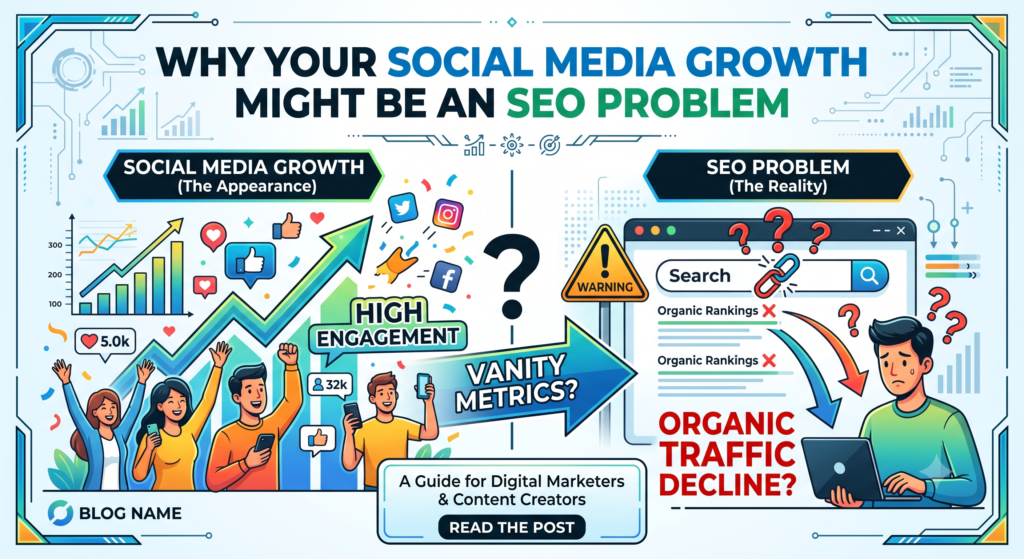
Why Your Social Media Growth Might Actually Be an SEO Problem

Most people talk about SEO and social media like they’re two different departments that occasionally send each other memos. SEO is “the Google thing.” Social media is “the content thing.” They live in separate tabs, separate strategies, separate people on the team. That split doesn’t hold up anymore. And if you’ve ever wondered why a competitor’s Instagram post or LinkedIn article seems to show up everywhere — in Google results, in someone’s search when they type your niche plus “best,” in random blog roundups — you’re looking at SEO doing quiet work on a social post that never got a single paid boost. Here’s the part that surprises people: Google doesn’t just index websites. It indexes a lot of your social presence too. Your profiles are already competing in search Search “your name + your city” or “your business + service” and see what comes up. There’s a decent chance a LinkedIn profile, a Pinterest board, a YouTube video, or even a public Facebook page shows up on page one — sometimes above the actual website. That’s not an accident. Google treats these as crawlable, indexable pages, same as any blog post. Pinterest is the clearest example of a platform that’s basically a search engine wearing a social media costume. People go there to search for ideas, not to catch up with friends. If your pins aren’t titled and described with the actual terms people search for, you’re invisible on a platform built entirely around search intent. YouTube works the same way. It’s the second-largest search engine on the planet, full stop. A video titled “How I Fixed X” with zero keyword thought behind it competes against a title like “How to Fix X in 2026 (Step-by-Step)” — and loses, every time, regardless of which video is actually better. Captions and bios aren’t hashtags. They’re search fields. There’s a habit of treating hashtags as the “SEO of Instagram.” They’re not, not really — hashtags are mostly a discovery mechanism within the platform’s own feed and explore tab. The actual SEO-adjacent move is different: writing your bio, your captions, and your video descriptions with the specific words a real person would type into a search bar. If you run a bakery in Jaipur and your Instagram bio says “Sweet things for sweet people ,” Google has nothing to work with. If it says “Custom cakes and desserts in Jaipur,” you’ve just handed the algorithm something it can actually match to a search query. Same energy, more function. This matters The traffic loop nobody talks about more now than it used to, because Google has been folding social results directly into search — video carousels, “people also discuss,” image packs pulled straight from Pinterest and Instagram. The line between “search result” and “social post” is blurrier every quarter. The traffic loop nobody talks about Here’s the mechanism that actually moves numbers, not vibes: social posts that rank in search bring in people who’ve never heard of your brand and weren’t following you. That’s cold traffic, arriving through intent rather than through an algorithm deciding to show you their feed. Some of that traffic clicks through to your website. Some of it just searches your brand name next, which is its own signal Google pays attention to — branded search volume is a trust signal, and social visibility is one of the easiest ways to generate it without spending on ads. There’s also the boring but real backlink angle. A link in your Instagram or LinkedIn bio pointing to your website isn’t going to move mountains on its own — most of these are nofollow, so they don’t pass the traditional “SEO juice” people love talking about. But they generate actual click traffic, and traffic that converts or engages is still worth more than a theoretical ranking boost that never brings a single real visitor. Where this gets oversold, and where it’s genuinely true To be fair to the skeptics: social media “likes” and “shares” are not a direct Google ranking factor. Google has said this repeatedly, and testing backs it up. So if someone tells you “post more on Instagram to rank higher on Google,” that’s the oversimplified, LinkedIn-guru version of the truth. What to actually do with this • Treat your social bios and “about” sections as if they’re meta descriptions — because functionally, they behave like one. • Write video titles and descriptions for search intent first, personality second. • Stop assuming hashtags are doing SEO work. They’re doing discovery work. Different job. • Track how much traffic actually arrives at your site from social search results, not just social feeds — Google Search Console will show you some of this if your content is indexed. • Pick one platform where search behaviour is dominant (YouTube, Pinterest, sometimes LinkedIn for B2B) and optimise that one properly before spreading the effort thin across five. SEO and social media were never really separate. They just got marketed that way by people selling separate services.  
Marketing

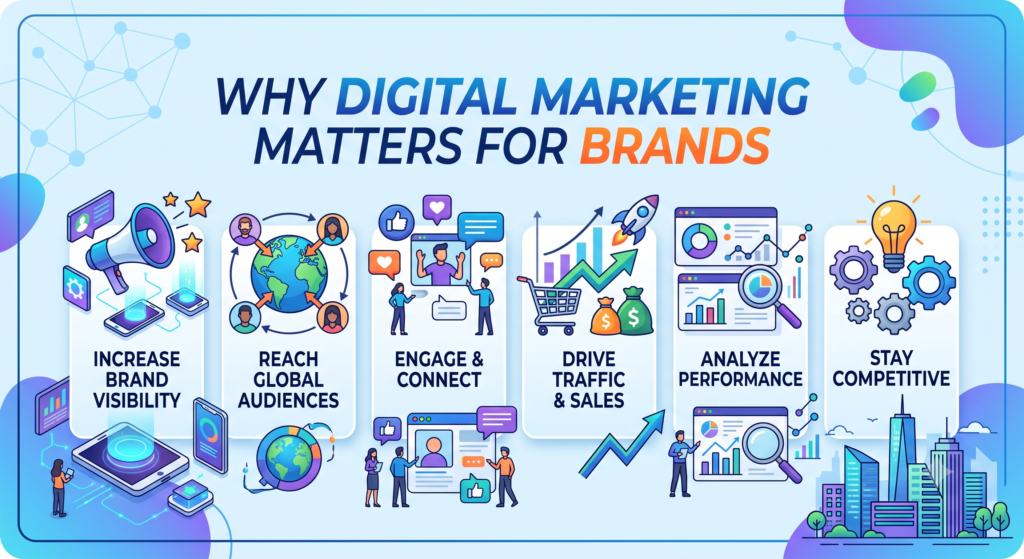
Why Digital Marketing Matters for Brands Today

The Shift That Already Happened Brands that still treat digital marketing as an “add-on” to traditional advertising are operating on outdated math. The customer journey doesn’t start at a billboard or a TV spot anymore — it starts with a search query, a scroll through Instagram, or a comment on a Reddit thread. If a brand isn’t visible in those moments, it doesn’t lose a sale; it never enters the consideration set at all. This isn’t a trend piece about “digital is the future.” Digital marketing stopped being the future around a decade ago. What’s changed recently is the cost of ignoring it — and that cost has gone up sharply. Attention Is Fragmented, and That’s Not Going Back A few years ago, a brand could reach most of its audience through two or three channels. Today, the same audience is split across search, short-form video, private messaging apps, niche communities, and AI-driven answer engines. This fragmentation means: • Reach requires more channels, not more budget on one channel. Spending twice as much on a single platform doesn’t compensate for being absent on three others. • Consistency matters more than intensity. A brand showing up modestly across five relevant channels usually outperforms one shouting loudly on a single channel. • Owned audiences (email lists, communities) are becoming insurance against algorithm changes. Platforms can and do change reach overnight; brands that rely entirely on organic social discovery are exposed to that risk. Search Behaviour Is Being Rewritten This is the part most brands are underestimating right now. Search isn’t just “Google it” anymore. People are asking ChatGPT, Claude, and Perplexity for recommendations. This has real consequences: 1. Traditional SEO tactics (keyword stuffing, backlink farms) are losing relevance. AI answer engines synthesize information rather than ranking pages, so being mentioned accurately and credibly across the web matters more than ranking #1 on a results page. 2. Structured, factual, well-sourced content performs better in this environment because AI systems favor clarity and verifiable claims over marketing fluff. 3. Brand reputation across third-party sources (reviews, forums, comparison sites) now feeds directly into how AI describes a brand to a potential customer — a brand has far less control over this narrative than it did over its own website copy. Brands that only optimise for Google’s blue links are optimising for a shrinking slice of discovery. Trust Is Harder to Buy, Easier to Lose Consumers, especially younger ones, are more skeptical of polished advertising and more responsive to peer validation — reviews, creator content, and word-of-mouth amplified digitally. This shifts the job of digital marketing from “persuade” to “prove”: • A well-produced ad can generate awareness, but a genuine customer testimonial or a creator’s honest review often does more to convert. • Negative experiences spread faster and further than positive ones. A single viral complaint can undo months of paid campaign work. • Brands that engage transparently (responding to criticism, admitting mistakes) are rewarded with more trust than brands that stay silent or delete comments. This means digital marketing today includes reputation management as a core function, not a crisis-response afterthought. Personalisation Has Become the Baseline Expectation Data-driven personalization used to be a differentiator. Now it’s table stakes. When a customer gets a generic email blast instead of a relevant recommendation, it doesn’t just underperform — it signals that the brand hasn’t invested in understanding its audience. This raises the bar for: The Cost of Measurement Has Dropped, So Excuses Have Too One of the strongest arguments for digital marketing is also the most practical: almost everything is measurable. Click-through rates, conversion funnels, cost-per-acquisition, engagement quality — brands can see, in near real time, what’s working and what isn’t. This changes the operating model: • Budgets can be reallocated within days instead of waiting for a campaign cycle to end. • Weak creative or messaging can be identified early through A/B testing rather than discovered post-mortem. • ROI can be tied to specific channels and campaigns rather than estimated from brand-lift surveys. Brands that don’t use this data are essentially choosing to market blind in an environment where blindness is optional. Small and Mid-Sized Brands Have a Real Shot Perhaps the most underrated shift: digital marketing has lowered the entry barrier for brands that could never have afforded national TV campaigns or billboard placements. A well-targeted social campaign or a strong content strategy can let a smaller brand compete for attention against much larger competitors — not on budget, but on relevance and creativity. This has intensified competition, but it’s also why digital marketing skills are in higher demand than ever: the tools are accessible, but using them well is not automatic. What This Means Practically For a brand deciding where to invest attention right now, three priorities stand out: 1. Build for AI-mediated discovery, not just search engine rankings — credibility across the web matters more than keyword density. 2. Treat trust and reputation as active marketing functions, not passive outcomes of good products. 3. Use data to cut weak tactics fast rather than running campaigns on assumption alone. Digital marketing isn’t valuable because it’s new. It’s valuable because it’s where the audience already is, it’s measurable, and it rewards brands that adapt faster than their competitors do. The brands losing ground right now aren’t losing because digital marketing doesn’t work — they’re losing because they’re still marketing like it’s optional.

Scroll to Top